

IndividuoAntisocial
New member
Who was Nikolai Girenko?
Nikolai Mikhailovich Girenko was a Russian ethnographer, Africanist, university lecturer, and human rights activist. He was born on October 31, 1940, in Leningrad, Soviet Union (now Saint Petersburg, Russia). He graduated from Leningrad State University in 1967 with a degree in African studies and later specialized in ethnography.
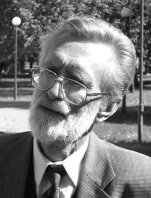
Photo of Nikolai Girenko
In 1970, Girenko began working at the Institute of Ethnography of the Soviet Academy of Sciences. Over the following decades, he established himself as a respected scholar, conducting research on African cultures and ethnic relations while also teaching at the Kunstkamera (Peter the Great Museum of Anthropology and Ethnography), where he educated future anthropologists and historians.
Following the collapse of the Soviet Union, Girenko became increasingly involved in public life. Citizens of Saint Petersburg elected him to the first democratically elected Lensovet (Leningrad City Council), where he served from 1990 to 1993. Beyond his academic career, he led initiatives dedicated to defending the rights of ethnic and religious minorities and organized educational programs that promoted tolerance, intercultural understanding, and opposition to racism and political extremism.
Because of his expertise in ethnography and extremist movements, Girenko frequently served as an expert witness in Russian courts. He testified in cases involving neo-Nazi organizations, including Russian National Unity (RNE) and Schulz-88, providing professional analyses of extremist propaganda, hate speech, and ideologically motivated violence. Throughout his career, he prepared approximately two dozen expert opinions related to nationalist organizations and murders motivated by ethnic hatred.
What was the Borovikov-Voevodin gang?
The Borovikov-Voevodin gang was a Russian neo-Nazi group active in St. Petersburg between 2003 and 2006 guilty of the murder of Nikolai Girenko. It was founded and led by Dmitry Borovikov and co-founder Alexey Voevodin, both neo-Nazi skinheads of that era. What distinguished this group from other neo-Nazi skinhead gangs of the time was their intent to kill and their planning of more complex assassinations (such as the one we will discuss today) as they considered that typical skinhead assaults, acts of classic vandalism, and random beatings were ineffective, instead advocating carefully planned assassinations of individuals they viewed as ideological or political enemies. Their modus operandi involved keeping a low profile, wearing inconspicuous clothing, and avoiding street-level altercations. Its members included Artem Prokhorenko, Andrei Kostrachenkov, Alexey Kostrachenkov, and Pavel Rumyantsev, all of whom participated in the murder I will describe today.
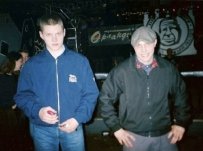
Dmitry Borovikov / Alexey Voevodin
 Andrei Kostrochenkov
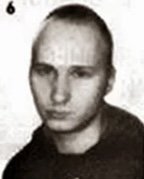 Alexey Kostrochenkov
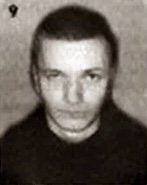 Artem Prokhorenko
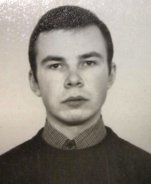 Pavel Rumyantsev
Why did they kill Nikolai Girenko?
Schulz-88 was a Russian neo-Nazi skinhead gang to which Dmitry Borovikov and Alexey Voevodin belonged for a time before forming their own neo-Nazi group. Schulz-88 had been analyzed in court by expert witness Nikolai Girenko. In theory, this was the primary reason why Dmitry Borovikov decided to plot Girenko's murder. According to one of the gang members, Dmitry Borovikov stated the following regarding why Nikolai Girenko had to be killed: "Girenko is a Russophobe, an anti-fascist, and an expert. Thanks to his expert analysis, our men are in prison."
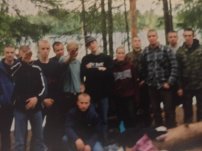
Schulz-88
The murder
On June 19, 2004, around 11 0 a.m, Andrei Kostrachenkov, Artem Prokhorenko, Alexey Voevodin, and Pavel Rumyantsev, all dressed in dark clothing and wearing baseball caps arrived at the building where 63-year-old ethnographer and human rights activist Nikolai Mikhailovich Girenko lived. Artem Prokhorenko and Andrei Kostrachenkov entered the building through the main entrance; Prokhorenko carried a bag over his shoulder containing a sawed-off German Mauser rifle, while Rumyantsev and Voevodin remained in the courtyard archway to act as lookouts. Prokhorenko rang the doorbell; Girenko’s daughter, Kalinina, went towards the door, saw two young men in baseball caps through the peephole and asked what they wanted. Andrei Kostrachenkov said, "May I speak with Nikolai Mikhailovich, please?" She called her father and went into another room of the house. When Girenko approached the door and asked, "Who is it?" Prokhorenko pulled the sawed-off Mauser rifle from the bag and fired a shot through the door. The bullet passed through the old door and was deflected, yet it still struck Girenko between his chest and right shoulder, piercing his arm, his armpit and severing the subclavian artery, killing him almost instantly. Girenko’s daughter ran into the hallway and found her father lying on the floor in a pool of blood. The bullet had also knocked down a mirror hanging in the hallway and embedded itself in the wall. Kalinina called an ambulance, but her father had already passed away. After the murder, the bag containing the rifle was handed over to Alexei Kostrachenkov, Andrei Kostrachenkov’s brother.
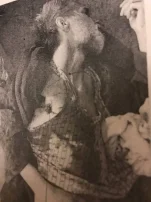
A photo of Girenko’s body
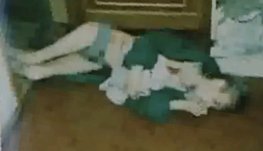
Another angle of Girenko’s body
The day before, on June 18, Alexey Voevodin and Dmitry Borovikov had already gone to the address with the intention of killing Girenko. They rang the doorbell, but no one answered. However, as they were heading back down, they ran into their target, Nikolai Girenko, on the stairs. Acting spontaneously in that situation was too risky, so they simply walked past him without arousing suspicion.
The accused explain how the murder was planned:
The murder weapon chosen was a sawed-off German Mauser rifle. We chose it because, first of all, it has excellent penetrating power, and the plan was to shoot through a door. Obviously, someone like Nikolai Girenko wouldn’t open the door to strangers. A Mauser bullet loses hardly any speed or penetrating power upon impact with a wooden door. We didn't know how many doors the victim had, but usually, there is an iron door first. The apartment was in an old building, and by all appearances, the doors had never been replaced; they were almost as old as the building itself. We assumed that if there was a second door, it would undoubtedly be made of wood. However, there was no way to verify these assumptions. We had to go to a forest shooting range to simulate the upcoming action and test the rifle. We found some boards of the appropriate thickness. First, we set up one. The bullet passed through it smoothly and reliably. Then we set up two plywood boards, spaced about ten centimeters apart. Again, the bullet easily passed through both boards. The practice shots demonstrated that it would easily pass through a person.
Explanation of the accused regarding how they obtained the weapon and how it operated:
In February 2004, Andrei Kostrochenkov, Artem Prokhorenko, and a few other gang members went to the home of their friend P., who sold them a sawed-off German Mauser rifle. A couple of weeks later, that same friend called him and asked him to teach Artem how to shoot it. He agreed. They arranged a meeting, and one day in March, he and Artem fired the sawed-off rifle in the woods near the Sapernoye train station. They were unable to ready the sawed-off Mauser and fire it immediately, after gathering the ammunition, Artem left. Following this encounter, Artem began calling him and suggesting they try out the Mauser again. He refused, but Artem threatened him, and under pressure, he was forced to agree. A week later, they met at the same spot. This time, Artem managed to ready the sawed-off rifle and fire it a couple of times. There was an old bus laying in the woods and it served as the target. The extractor on the sawed-off rifle was not working, so after firing, they would open the bolt and remove the spent casing using a stick or a piece of wire. After the second shot, the casing failed to eject, so they did not fire again. After checking the weapon, they returned to the city.
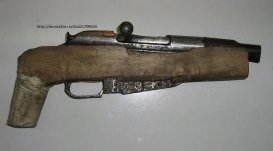
Photo of the sawed-off Mauser rifle
The rifle itself was very old and assembled from various different parts; it was a sawed-off model. The bolt mechanism was broken, so it could not be reloaded manually. In other words, the weapon could only be fired once. After that, one had to use pliers to open the bolt, insert a new cartridge, and only after all these steps was the Mauser ready to fire again.
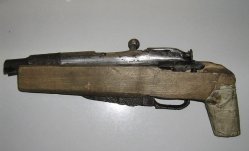
The rifle from another angle
In the photo we can appreciate that there’s not trigger. This may be due to the police investigation where they could have removed it. Also another explanation may be that it didn’t really have a trigger, so they would just push the bolt forwards from behind using their hand, making the gun fire.
If someone enjoyed this case and wants to know other similar ones I could share the detailed list of each murder of the Borovikov-Voevodin gang I made.
Nikolai Mikhailovich Girenko was a Russian ethnographer, Africanist, university lecturer, and human rights activist. He was born on October 31, 1940, in Leningrad, Soviet Union (now Saint Petersburg, Russia). He graduated from Leningrad State University in 1967 with a degree in African studies and later specialized in ethnography.
Photo of Nikolai Girenko
In 1970, Girenko began working at the Institute of Ethnography of the Soviet Academy of Sciences. Over the following decades, he established himself as a respected scholar, conducting research on African cultures and ethnic relations while also teaching at the Kunstkamera (Peter the Great Museum of Anthropology and Ethnography), where he educated future anthropologists and historians.
Following the collapse of the Soviet Union, Girenko became increasingly involved in public life. Citizens of Saint Petersburg elected him to the first democratically elected Lensovet (Leningrad City Council), where he served from 1990 to 1993. Beyond his academic career, he led initiatives dedicated to defending the rights of ethnic and religious minorities and organized educational programs that promoted tolerance, intercultural understanding, and opposition to racism and political extremism.
Because of his expertise in ethnography and extremist movements, Girenko frequently served as an expert witness in Russian courts. He testified in cases involving neo-Nazi organizations, including Russian National Unity (RNE) and Schulz-88, providing professional analyses of extremist propaganda, hate speech, and ideologically motivated violence. Throughout his career, he prepared approximately two dozen expert opinions related to nationalist organizations and murders motivated by ethnic hatred.
What was the Borovikov-Voevodin gang?
The Borovikov-Voevodin gang was a Russian neo-Nazi group active in St. Petersburg between 2003 and 2006 guilty of the murder of Nikolai Girenko. It was founded and led by Dmitry Borovikov and co-founder Alexey Voevodin, both neo-Nazi skinheads of that era. What distinguished this group from other neo-Nazi skinhead gangs of the time was their intent to kill and their planning of more complex assassinations (such as the one we will discuss today) as they considered that typical skinhead assaults, acts of classic vandalism, and random beatings were ineffective, instead advocating carefully planned assassinations of individuals they viewed as ideological or political enemies. Their modus operandi involved keeping a low profile, wearing inconspicuous clothing, and avoiding street-level altercations. Its members included Artem Prokhorenko, Andrei Kostrachenkov, Alexey Kostrachenkov, and Pavel Rumyantsev, all of whom participated in the murder I will describe today.
Dmitry Borovikov / Alexey Voevodin
Andrei Kostrochenkov Alexey Kostrochenkov Artem Prokhorenko Pavel RumyantsevWhy did they kill Nikolai Girenko?
Schulz-88 was a Russian neo-Nazi skinhead gang to which Dmitry Borovikov and Alexey Voevodin belonged for a time before forming their own neo-Nazi group. Schulz-88 had been analyzed in court by expert witness Nikolai Girenko. In theory, this was the primary reason why Dmitry Borovikov decided to plot Girenko's murder. According to one of the gang members, Dmitry Borovikov stated the following regarding why Nikolai Girenko had to be killed: "Girenko is a Russophobe, an anti-fascist, and an expert. Thanks to his expert analysis, our men are in prison."
Schulz-88
The murder
On June 19, 2004, around 11
0 a.m, Andrei Kostrachenkov, Artem Prokhorenko, Alexey Voevodin, and Pavel Rumyantsev, all dressed in dark clothing and wearing baseball caps arrived at the building where 63-year-old ethnographer and human rights activist Nikolai Mikhailovich Girenko lived. Artem Prokhorenko and Andrei Kostrachenkov entered the building through the main entrance; Prokhorenko carried a bag over his shoulder containing a sawed-off German Mauser rifle, while Rumyantsev and Voevodin remained in the courtyard archway to act as lookouts. Prokhorenko rang the doorbell; Girenko’s daughter, Kalinina, went towards the door, saw two young men in baseball caps through the peephole and asked what they wanted. Andrei Kostrachenkov said, "May I speak with Nikolai Mikhailovich, please?" She called her father and went into another room of the house. When Girenko approached the door and asked, "Who is it?" Prokhorenko pulled the sawed-off Mauser rifle from the bag and fired a shot through the door. The bullet passed through the old door and was deflected, yet it still struck Girenko between his chest and right shoulder, piercing his arm, his armpit and severing the subclavian artery, killing him almost instantly. Girenko’s daughter ran into the hallway and found her father lying on the floor in a pool of blood. The bullet had also knocked down a mirror hanging in the hallway and embedded itself in the wall. Kalinina called an ambulance, but her father had already passed away. After the murder, the bag containing the rifle was handed over to Alexei Kostrachenkov, Andrei Kostrachenkov’s brother.A photo of Girenko’s body
Another angle of Girenko’s body
The day before, on June 18, Alexey Voevodin and Dmitry Borovikov had already gone to the address with the intention of killing Girenko. They rang the doorbell, but no one answered. However, as they were heading back down, they ran into their target, Nikolai Girenko, on the stairs. Acting spontaneously in that situation was too risky, so they simply walked past him without arousing suspicion.
The accused explain how the murder was planned:
The murder weapon chosen was a sawed-off German Mauser rifle. We chose it because, first of all, it has excellent penetrating power, and the plan was to shoot through a door. Obviously, someone like Nikolai Girenko wouldn’t open the door to strangers. A Mauser bullet loses hardly any speed or penetrating power upon impact with a wooden door. We didn't know how many doors the victim had, but usually, there is an iron door first. The apartment was in an old building, and by all appearances, the doors had never been replaced; they were almost as old as the building itself. We assumed that if there was a second door, it would undoubtedly be made of wood. However, there was no way to verify these assumptions. We had to go to a forest shooting range to simulate the upcoming action and test the rifle. We found some boards of the appropriate thickness. First, we set up one. The bullet passed through it smoothly and reliably. Then we set up two plywood boards, spaced about ten centimeters apart. Again, the bullet easily passed through both boards. The practice shots demonstrated that it would easily pass through a person.
Explanation of the accused regarding how they obtained the weapon and how it operated:
In February 2004, Andrei Kostrochenkov, Artem Prokhorenko, and a few other gang members went to the home of their friend P., who sold them a sawed-off German Mauser rifle. A couple of weeks later, that same friend called him and asked him to teach Artem how to shoot it. He agreed. They arranged a meeting, and one day in March, he and Artem fired the sawed-off rifle in the woods near the Sapernoye train station. They were unable to ready the sawed-off Mauser and fire it immediately, after gathering the ammunition, Artem left. Following this encounter, Artem began calling him and suggesting they try out the Mauser again. He refused, but Artem threatened him, and under pressure, he was forced to agree. A week later, they met at the same spot. This time, Artem managed to ready the sawed-off rifle and fire it a couple of times. There was an old bus laying in the woods and it served as the target. The extractor on the sawed-off rifle was not working, so after firing, they would open the bolt and remove the spent casing using a stick or a piece of wire. After the second shot, the casing failed to eject, so they did not fire again. After checking the weapon, they returned to the city.
Photo of the sawed-off Mauser rifle
The rifle itself was very old and assembled from various different parts; it was a sawed-off model. The bolt mechanism was broken, so it could not be reloaded manually. In other words, the weapon could only be fired once. After that, one had to use pliers to open the bolt, insert a new cartridge, and only after all these steps was the Mauser ready to fire again.
The rifle from another angle
In the photo we can appreciate that there’s not trigger. This may be due to the police investigation where they could have removed it. Also another explanation may be that it didn’t really have a trigger, so they would just push the bolt forwards from behind using their hand, making the gun fire.
If someone enjoyed this case and wants to know other similar ones I could share the detailed list of each murder of the Borovikov-Voevodin gang I made.
Last edited: